A close friend once told me that nothing improves without change. So be it. The journey toward improvement and change is often littered with the corpses of the innocent.
Slowly, quietly, and with little public knowledge, it appears as if search giant Google is molding the world wide web into a more efficient money machine and creating a new era where Google rules the internet with an iron fist.
Killing Not Softly
My perspective on Google’s efforts to reshape the web are aimed at Matt Cutts, a Google executive who is often the public face of the company’s search engine, particularly the web spam component.
Web spam? Yes. Google makes most of its enormous riches from advertising born from search engine results. To Google, you’re not the customer. You’re the product.
Enter a search term into Google’s web site or apps, and the resulting list contains, hopefully, an answer to what you searched for, and an option to click on advertisements sprinkled in among the results.
Web spam, or spamdexing, is the deliberate manipulation of search engine indexes. There’s a whole cottage industry that uses secretive, black hat search engines tricks to get web sites to be listed higher in Google’s search rankings.
The obvious reason for spamming search engines is financial. With a higher rank a web site often receives more search referrals from Google and other search engines. More referrals mean more page views, which mean more ads are displayed, which often means more money.
Through the years Google has instituted a number of schemes to find and negate ranking tricks, and reduce the number of content farm sites which show up in Google’s search results.
The most notorious of Google’s efforts to combat content spam and flush out content farms is known as Panda, launched in February 2011. Since then, a number of Panda updates changed how Google ranks web sites in search results.
The intent is obvious. The web is a messy place and Google wants to clean up the web spam and content farm so search results list legitimate web sites with worthy content.
Unfortunately, Google’s math, the algorithms that constitute Panda’s efforts to separate the wheat from the chaff, is flawed. If ever there was a picture worth a thousand words, this is it (click on the image for a larger, pop up view).
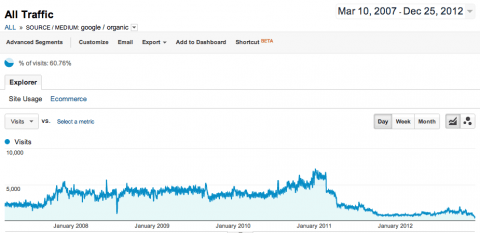
What you see in the chart above is search referrals from Google Analytics for Mac360 going back to March, 2007. Prior to that we used Urchin stats, which was purchased by Google and became Google’s Analytics service.
From inception in 2004 to February of 2011, Mac360’s referrals from Google mostly increased. Sometimes traffic was up, sometimes down, but overall there was a growing amount of traffic referred to Mac360 by Google search engine results.
And, why not? Mac360 is a web site about the Mac, with Mac app reviews, and occasional Apple-related commentary. Mac360 is not a web spam site, not a content farm. 100-percent of the site’s content is original and created by a small staff of dedicated writers and long time Mac users.
We’ve published nearly 4,000 reviews, articles, news items, and commentary since 2004. Popular reviews tend to have a good shelf life and often receive tens of thousands of referral visits after publication.
In the graphic above you’ll see three distinct events in the timeline where referral traffic from Google dropped dramatically. All coincide perfectly with major Panda changes; how Google rates and ranks sites in their search results.
At the high point in January 2011, Google referrals averaged 6,500 visitors per day. Today’s Google referrals stand at almost 400. That’s a nearly 95-percent drop in referral traffic. Not 20-percent. Not 50-percent. Over 90-percent.
Why? Google claims that Panda’s changes are designed to rid search results of web spam sites and content farm sites; minimal content which adds little value, or content which is not original (often shared among many web sites), or does not meet some mysterious criteria known only to Google’s engineers.
That dramatic drop in referral visitor traffic had devastating effects on Mac360. As revenue falls, we can no longer pay writers. For now, all contributions are voluntary.
Mac360 does not and has never used black hat search engine tricks to gain higher ranking. Tricks like keyword stuffing have never been employed. In fact, keywords themselves are mostly worthless in search engine rankings. What we do is simple. We write reviews and occasional commentary on the Mac and Apple (and recently added iOS app reviews). That’s it.
So, what happened? In Google’s attempt to clean up their search results and make them more relevant, engineers use sophisticated and complex algorithms to determine a site’s value and ranking. While that may work to rid search results of the worst offenders, there’s also collateral damage. Thousands of legitimate sites with relevant content have been crushed to oblivion by Google’s clumsy attempts to remake the web for their greater profit.
One part of the criteria Google uses to rank sites is advertising; specifically, the number of relevant ads on a site. Some sites exist solely to run advertisements and Google doesn’t want those sites to show up in their search results because the content on those sites is mostly worthless. That’s understandable.
Mac360 began to display advertisements after receiving a phone call from a Google AdSense account representative who insisted that our traffic numbers would result in monthly revenue of around $2,500. She was wrong, of course. But we do have advertisements from Google AdSense and Tribal Fusion (another popular ad network). Those ads help to pay for servers and bandwidth and support, with a little left over to share with writers.
Interestingly, daily visits to Mac360 from our RSS feed or bookmarks have remained mostly steady due to a loyal following. Despite the damage Panda has caused, there is no recourse, no higher court to make an appeal.
Google has stated publicly that web sites with too many advertisements on their pages will suffer in search engine rankings. Maybe that’s the case. Or, maybe Google simply wants to eliminate AdSense competition.
Regardless, slowly, steadily, Google is remaking the web in a new image by arbitrarily selecting which sites to favor and promote and which sites fall into disfavor and are discarded. Google’s rules for content remain unclear, ambiguous, and general in nature. Why? It’s math. Instead of a person, an algorithm determines ranking and results. No human is involved. Legitimate sites with unique, original content and a steady stream of visitors which are shunned by Google are merely collateral damage.
Google does not care about the web or content. Google cares about revenue and profits, and if cleaning out the cruft of offending sites improves search results (and revenue and profits), it’s a minor issue that legitimate, worthy sites are not ranked as they once were.
It wasn’t that long ago that another industry titan, Microsoft, attempted to remake the web in an image more conducive to their business model. Microsoft became a monopoly and gained tremendous riches and power. That is where Google is now. Rich and powerful. And, like Microsoft before, full of hubris and arrogance in a vain attempt to extend the monopoly and crush competition.
Where is Microsoft today? Still rich. Yet, despite all the tens of billions spent to become relevant beyond Windows and Office, Microsoft has totally missed the rapidly growing mobile revolution, and is in danger of becoming an asterisk to the future of computing.
Where is Google today? Still rich, yes. Yet, despite all the tens of billions spent to become relevant beyond search engine advertising, Google struggles in a desperate attempt to become anything but an also ran in the mobile revolution.
When it comes to ranking web sites in their search results, Google is free to do as it wishes and to protect and expand their business model. I see similarities between Microsoft and Google. Neither views a user as the customer. To Google, you, the user of Google search and Google’s free applications, are not the customer. You’re the product, constantly creating personal data to be culled and packaged and sold to the highest bidder.
Industry titans that pay little attention to the customer experience often become relics in the future. One day Google will fall from prominence. There is even evidence of that today. Google struggles mightily to make money in mobile computing, and has difficulty getting mobile customers to use their devices and software.
Google’s clumsy efforts to reshape the web to be more revenue friendly to its own objectives also destroys that which helped to make the company prosperous in the first place. One day Google will fall from prominence. And when that day comes I shall neither mourn nor shed a tear.

Leave a Reply